The Nightmare Continues
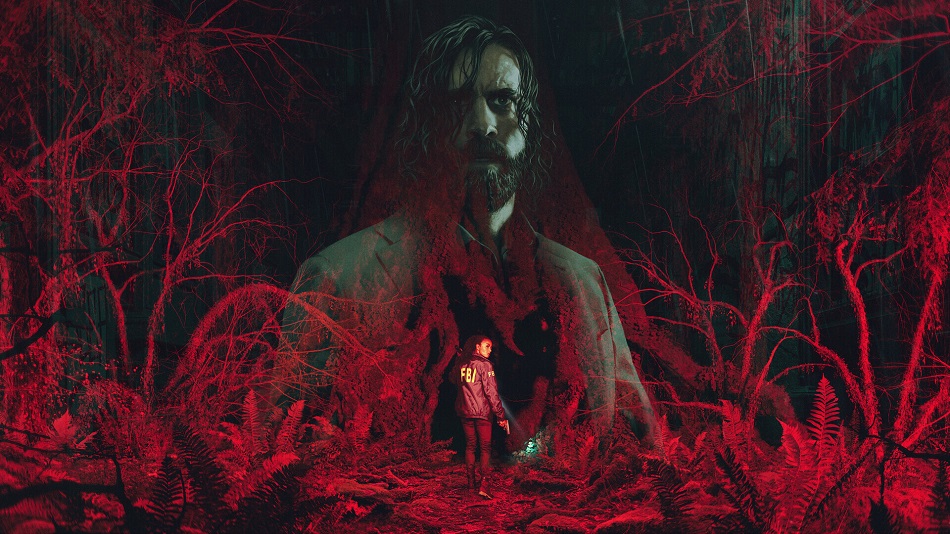
HIGH The game’s aesthetics and visual style.
LOW The slow-paced start and abrupt ending!
WTF Why do I need a supercomputer to run this?!?
Alan Wake 2 is Remedy’s next and incredibly ambitious project, and it comes in the form of a third-person survival horror that nails it in some areas and misses in some others.
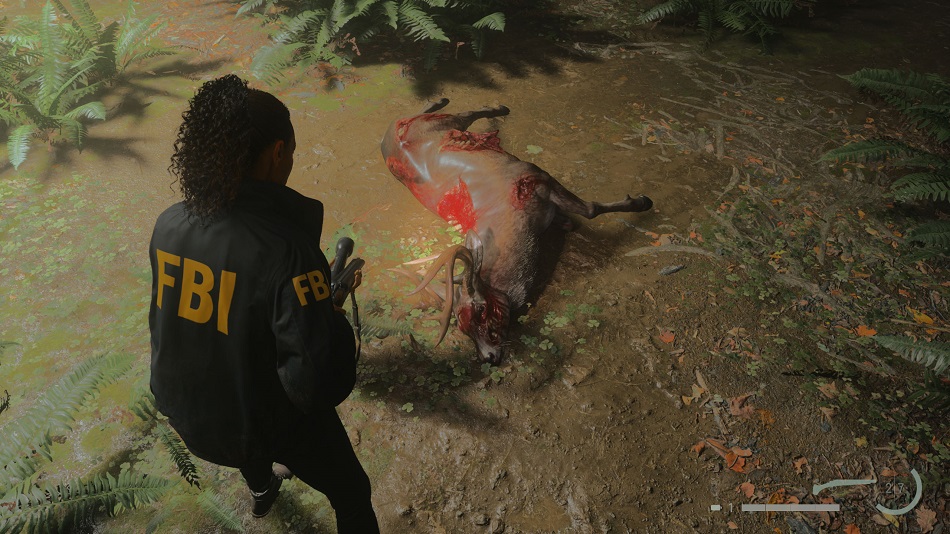
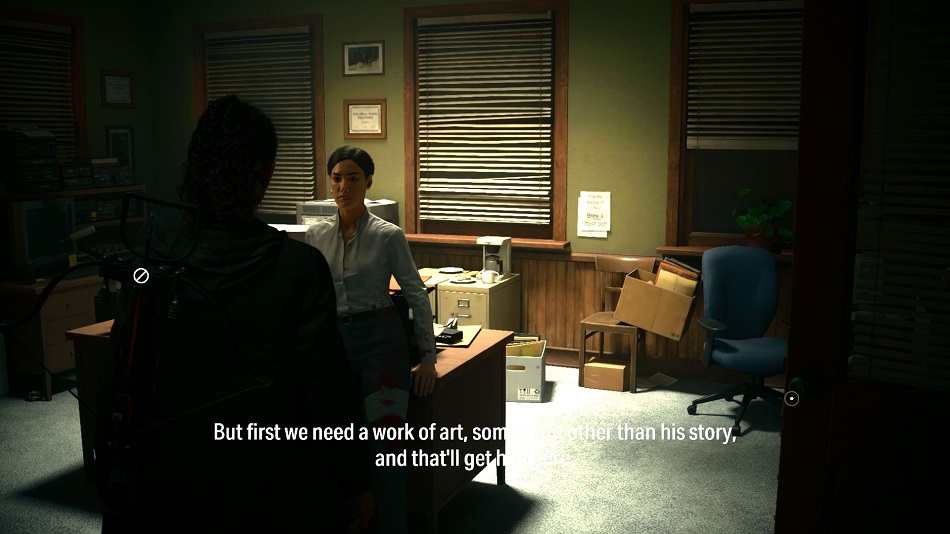
Alan Wake 2 starts 13 years after the events of the first. While the titular writer has been missing since then, a murderous group calling themselves the Cult of the Tree have killed many people in the Cauldron Lake area where both games were set. FBI agent Saga Anderson and her partner are assigned to the case, hoping to shed some light on these killings.
Just like the first, Alan Wake 2 is a third-person survival horror, with both action and puzzle-solving. In the action segments, the player will use a flashlight to make ‘dark’ enemies vulnerable before engaging in gunfights with them. Due to its narrative-focused nature, the world has a semi-open design. Players are
largely free to explore different regions, but a loading screen awaits them when transitioning between areas. Switching between Alan and Saga is only possible in safe rooms where the game can be saved.
While there are different types of upgradable weapons, the combat is nothing special. Enemies use ranged and melee attacks against the player and attacks can be dodged to stagger foes and earn some breathing room. That said, one twist during Alan’s portions are that not all entities in Dark Place are hostile. Because Alan never knows which of the shadows calling his name is his next adversary, the player will often find themselves on the edge of their seats when roaming.
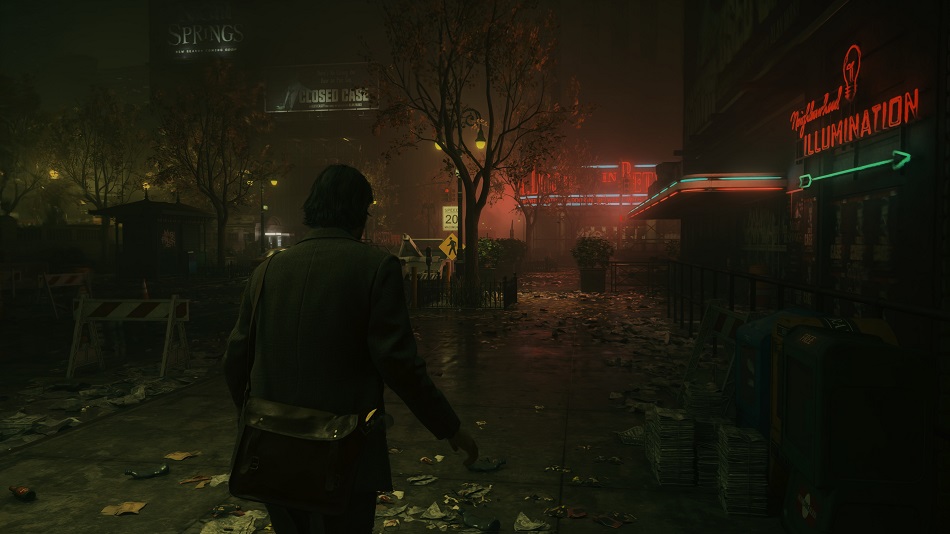
More innovative than the combat is Wake 2‘s narrative. The script follows two interconnected stories and characters in two distinct worlds. In one we accompany Alan in his attempt to find a way out of the supernatural Dark Place he’s trapped in, and the other is Saga and her detective work in the real world. It seemed to me that it would be tough balancing both fantastical and ‘real’ elements while keeping the two narratives connected throughout, but Remedy nailed it.
During Alan’s portions in a nightmarish New York-like setting, everything relies on environmental storytelling. Billboards warn about the inevitable failure of Alan’s mission. Neon lights of the shops on corners act as waypoints, glowing in the darkness of the rainy night. Graffiti on the walls points towards hidden stashes or skill points. On Saga’s side, her detective’s intuition is used to guide the player. She can go through the pieces of evidence found throughout the world in her virtual “Mind Place” to reach a conclusion and plan the next place to go or the next person to find.
Saga’s Mind Place can be accessed at any time via the push of a button, and presents like a small hut in which she walks around and interacts with casefiles and pieces of evidence. For example, if she puts the right real-world evidence next to the right mental question she has about the case, the question is answered.
Though the idea of the Mind Place is great, it’s not well-rooted, as players can go through most of the story without consulting the pieces of evidence Saga finds, and as the story unfolds over time, Saga will automatically file them into correct cases and come to a conclusion saying “I already know how this ends”.
While Alan doesn’t use a Mind Place, he can change the world around him by writing about it in his “Writer’s Room”. He can turn a lively ballroom into a scene of grisly murder by adding cultists to the story and then following their bloody trail of blood to the next key object needed in his quest. The general mechanics of Alan’s Writer’s Room is like Saga’s Mind Place, with the only difference being that when Alan puts a theme (murder, for example) next to a place (let’s say “ballrom”) then the world around Alan changes and new paths or items are revealed.
In terms of pacing, Alan Wake 2 suffers from opening hours that are almost completely devoid of any action. Things starts with Saga examining a crime scene in Cauldron Lake, introducing the detective work mechanics and how the Mind Place works. By the time her introduction is finished, the story switches to Alan and his intro, which includes solving puzzles by changing the environment with the Writer’s Room. The need for two intros is inevitable based on Remedy’s basic structure and the differences between the two leads, yet, the way they’re set one right after another with a heavy focus on puzzles in both is questionable.
Unfortunately, without spoiling anything, I can say that the ending of the adventure is underwhelming. Though the plot is full of surprises, the last hour boils down to being a fetch quest, and most of the anticipated action is done via cutscenes which rob the player of feeling like they’ve gotten the job done themselves.
Artistically, I have no doubt that Alan Wake 2 will frequently in any conversation about pushing boundaries. The game not only uses live-action cinematics in conjunction with CGI, but there are parts of gameplay when the Dark Place and the real world overlap. This is achieved by using a live-action sequence and overlaying it like a photo filter on the environment — not only a great idea to show how the two words (and narratives) affect each other, but it’s a truly unique visual experience. Character facial animations are also perfect, and it’s a rare treat to see a studio so committed to motion capture rather than auto-generating animations, as I found the performances far more realistic and emotionally engaging.
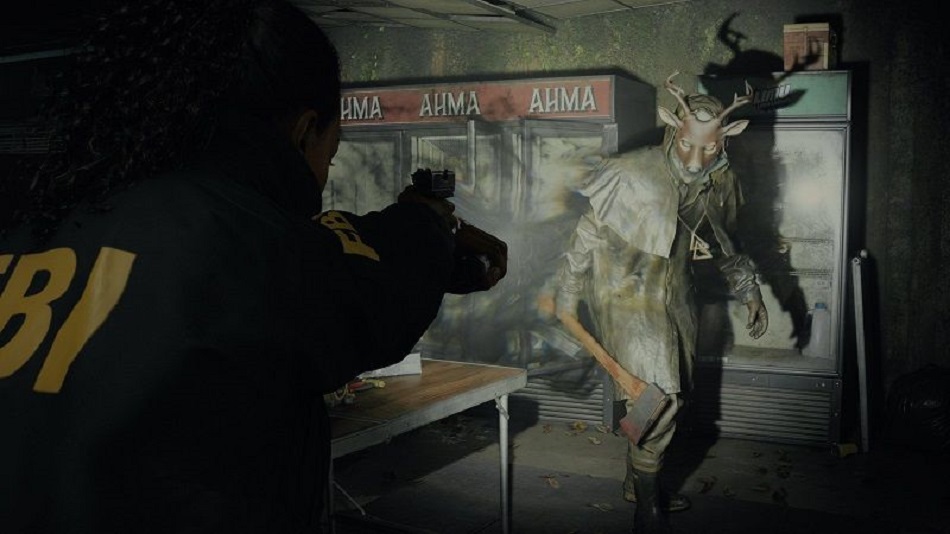
Combat also has some issues — things feel clunky in part due to the inventory management system.
Weapons and usable items like med packs can be assigned to eight ‘quick select’ menu slots assigned to four physical buttons on the keyboard and controllers. In order to select an item, the player should push the corresponding button either once for the primary item or twice for the secondary. This single or double-clicking method of switching is a frustrating pain during combat that made me choose the
wrong weapon or item in the heat of the fight many times. It’s strange why the devs chose to not go with something more standard like a radial ‘weapon wheel’ or even an older-school solution such as a “next/previous weapon” button.
One final thing to discuss are the technical aspects of running Alan Wake 2 on PC, where I reviewed it. The game truly takes ray tracing to the next level with various notable effects like reflections within reflections. The benefit is hugely atmospheric, but these great visuals come with great costs.
It’s impossible to get a solid 60FPS with Ray Tracing (even on 1080p resolution) without using DLSS and frame generation on an RTX 4080. For people who don’t know what this means, take it as Alan Wake 2 certainly being the next Crysis when it comes to testing and benchmarking PC hardware in upcoming years. However, the sad truth is that other current games use the same top-notch Ray Tracing technologies while offering much better performance and demanding less investment on the hardware side.
Alan Wake 2 is a unique experience thanks to the innovative blending of photorealism and traditional visual design, as well as a narrative deeply entwined to gameplay mechanics to an extent rarely seen before. It is not a perfect experience, but it is innovative enough to inspire gamers and devs alike for years to come.
Score: 8 out of 10
Disclosures: This game is developed by Remedy Entertainment and published by Epic Games. It is currently available on XBX/S, PS5 and PC. This copy of the game was obtained via publisher and reviewed on the PC. Approximately 18 hours of play were devoted to the single-player mode, and the game was completed. There are no multiplayer modes.
Parents: According to the ESRB, this game is rated M and contains Blood and Gore, Intense Violence, Nudity, and Strong Language. The official rating summary reads: Combat is highlighted by realistic gunfire, explosions, and blood-splatter effects; shooting enemies sometimes results in exposed entrails and large wounds. Cutscenes also depict instances of violence/blood… a character is depicted nude, with exposed genitalia and buttocks.
Colorblind Modes: There are no colorblind modes present.
Deaf & Hard of Hearing Gamers: This game offers subtitles. The subtitles can be altered and/or resized. There are some necessary audio cues in puzzle solving sections. There are some audio cues used in puzzle solving sections that are not accompanied by visual cues. This game is not fully accessible.
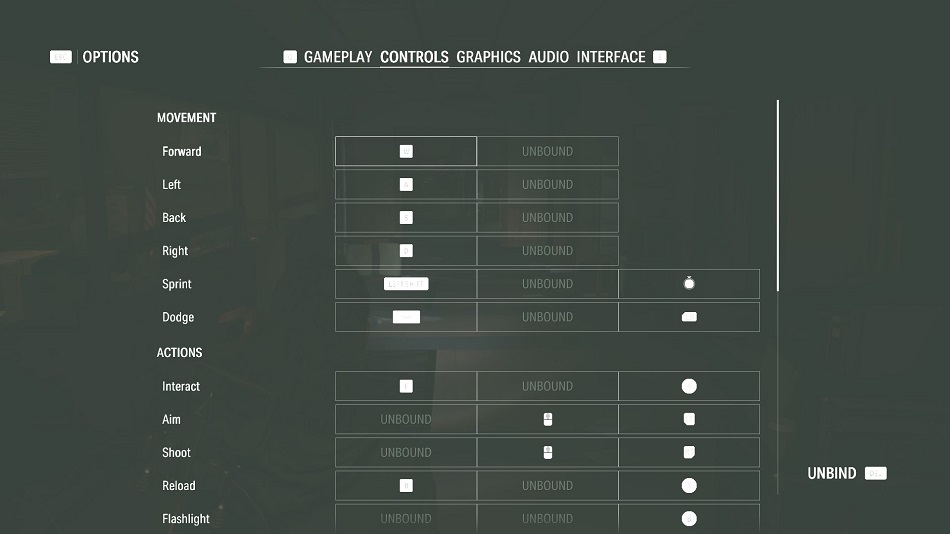
Remappable Controls: Controls can be remapped.

- Tempest Rising Review - November 10, 2025
- OPINION: The Good & Bad – Gamescom 2025 - October 1, 2025
- Atomfall Review - April 9, 2025
I don’t think I’ll be able to play this for some time since our PC is ten years old and we don’t have a PS5 yet. but I will play the first one on PS plus . I’m pretty interested in the story.
It is an experience that will remain fresh for years to come. Don’t need to hurry.