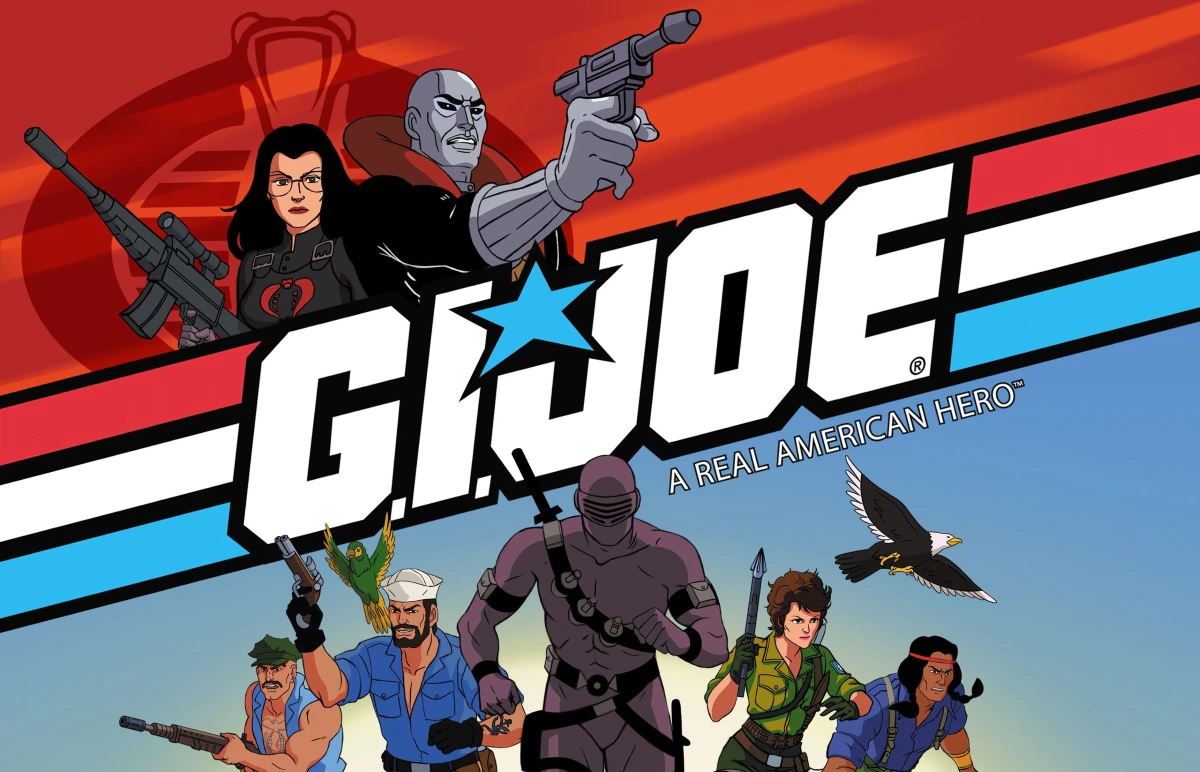
In my continuing effort to watch every episode of cartoons that I loved as a kid, the next one on my agenda was G.I. Joe: A Real American Hero — specifically, the Sunbow Productions run starting with the first installment of the original limited series, all the way through the regular episodes and finishing with G.I. Joe: The Movie.
(The series continued in a different run produced by DIC Entertainment for 44 more episodes.)
*
For those who aren’t familiar, G.I. Joe: A Real American Hero (shortened to ARAH in toy circles) was one of the most popular kids’ cartoons in the ’80s, running from 1983-1986 for a total of 95 episodes, beginning with a limited series, and then being greenlit for a full daily series. The premise is that G.I. Joe is an elite quick-response military team comprised of various specialists, all banding together to fight Cobra, a terrorist organization bent on world domination.
As a kid of the ’80s myself, my first exposure to the show was watching it whenever I caught it after coming home from school. However, as was the case with every TV show back then, you inevitably missed some episodes because you weren’t sitting in front of the TV at exactly the right time, or because one of your parents commandeered the set to watch something else — and if you did manage to catch the show, there was a good chance it would be a re-run, as it was common for episodes to be shown out of order, or simply repeated. So, thanks to modern streaming technology and being a grownup with my own TV set, it’s easier than it ever has been to watch the entire run of G.I. Joe in the correct order and on my own timeline — and that’s exactly what I did. It became a fun daily ritual for my wife and I to make coffee, grab a blanket for the couch and play an episode or two in the morning before we started our day.
I can’t lie, hearing the heroic theme song and seeing the blood-pumping intro sequence after so many years brought back all the feels, and it was great to see the action and adventure I remember from back in the day — Duke! Spirit! Snake Eyes and the rest of the heroic Joes! Cobra Commander, Major Bludd and legions of evil Cobra troops! Lasers! Cool vehicles! Explosions! Everything a kid in the ’80s could want!
…However, it wasn’t long before reality set in.
I’ve revisited a fair number of shows like this from the ’80s, and across the board I’m struck with the sense that we didn’t know how to structure TV shows back then. Kids’ programming rarely delivered quality storylines and well-written characters. If you’re as old as I am and saw G.I. Joe when it originally aired on TV like I did, it’s a good bet that you have positive feelings and nostalgia for it — I know I do! But during this watch of the complete series, it was hard to get past the untapped potential.
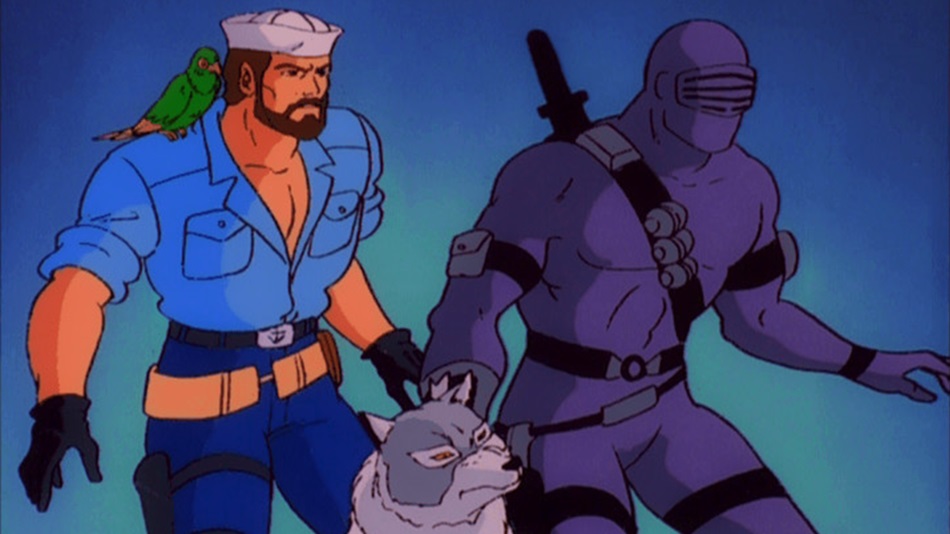
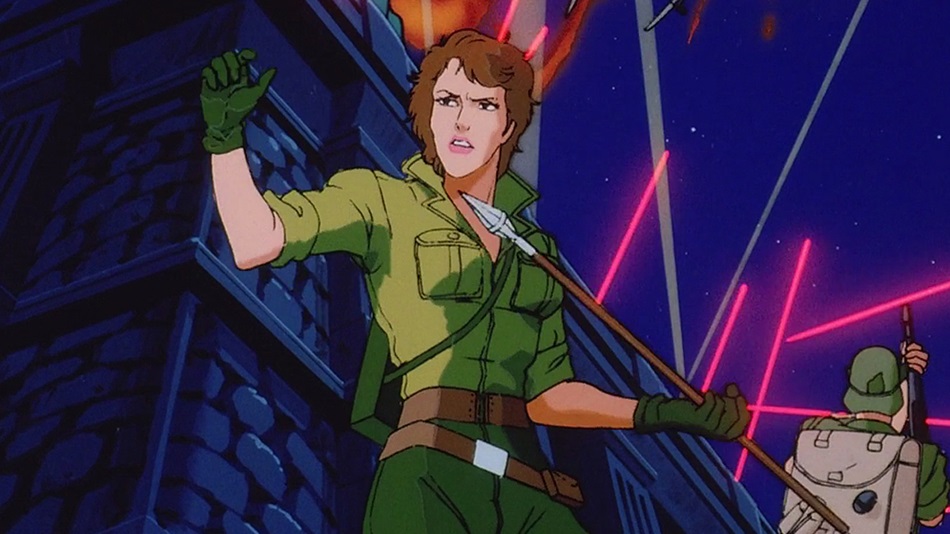
One of the most notable things is how thinly the characters are written. Only a few faces get enough airtime to stand out, primarily Shipwreck and Lady Jaye, but there were dozens of Joes altogether. Sadly, they seldom had any defining qualities beyond an accent and what their costume looked like.
I’m sure this can be attributed to a lack of production sense back then, but also to the show’s primary purpose of selling toys. Why spend several episodes on building up a character if they’re not on store shelves for kids to buy later? This approach also meant that it was common for your favorite character to suddenly disappear for no reason, only to be unceremoniously replaced with whoever the newest figure in stores was. Were you a fan of Dusty or Quick Kick? Too bad, they’re gone. Hope you like Blowtorch and Recondo, now available at retailers near you!
There was also a notable lack of continuity and no overarching story arcs once we got past the initial limited series — some elements persisted or were referred to in later episodes, but there was no narrative throughline like we have with many modern cartoons. Of course part of this is due to the fact that there was often no easy way for people to catch up on episodes they might have missed. As such, many programs (not just cartoons) leaned into stand-alone episodes for ease of viewing, but the ’80s were also a time when the toy companies footing the animation bill had absolutely no idea how powerful and lasting the connection could be between emotionally-invested kids and the characters they bonded with. It was unintentional, but these shows turned kids into lifelong customers.
Case in point: the vast majority of toys these days are purchased by adults, and sales of big ’80s IPs like ThunderCats, Masters of the Universe and yes, G.I. Joe, are almost entirely driven by fans who grew up with these programs forty years ago.
However, despite the fact that animation houses weren’t focused on building strong shows that could stand on their own, they often came close as writers returned to certain characters more often than others. It may not have been what the toy companies wanted, but it seems to me like the folks pushing pencils and pens were doing their best to add quality wherever and whenever they could.
On the Joe side, it was largely Shipwreck who brought personality as a sassy seagoing slacker. Alpine and Bazooka were a comedy duo (later replaced by bickering buddies Leatherneck and Wetsuit) and anyone who’s watched the show for any length of time knows that the real star of the show wasn’t Duke or Flint or Snake Eyes — it was Lady Jaye. She’s in more episodes than literally any other Joe, and she had no trouble getting things done on every mission. She was the real backbone of the team!
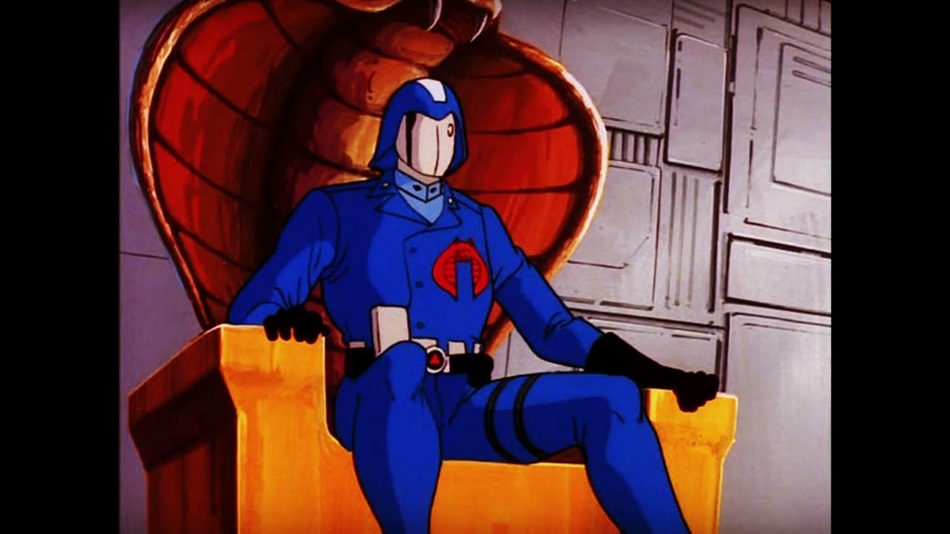
However, even stronger than the Joes were the Cobra troops. Almost all of the named characters had larger-than-life personalities and easily-recognizable quirks that made them endearing to kids. Cobra Commander’s mirror-masked face and shrieking voice made him one of the most iconic villains of the entire decade, but Destro’s sense of honor, deep baritone and silver head also made a strong impression. The Baroness is not only an all-time baddie thanks to her prowess in combat and subterfuge, but she’s always near the top of any ‘hottest’ list and the seed of domme fantasies cropping up later in a fan’s life. The finish-each-other’s-sentence twins Tomax and Xamot were never far from the fore, and Zartan’s penchant for disguise kept us guessing. Anytime a random civilian or scientist showed up, there was at least a 50% chance it would turn out to be Zartan!
With this core cast established, the writers dabbled in creating touchstones which could have been leveraged into meatier content — Several episodes referenced the secret Cobra base located in Springfield, we learned that Shipwreck was adopted and Scarlett came from a large family of martial arts experts, the renegade Zarana secretly pined for humble PC tech Mainframe, and so on. These rare glimpses of the Joes as people with histories, interests and lives off the battlefield were some of G.I. Joe‘s best moments of character elevation.
Unfortunately, one of the biggest missed character opportunities was late in the series when a new toy push from Hasbro began. The majority of established Joe characters were swapped out with unknown people overnight, and it was a huge surprise to see so many new faces arrive with no introduction, while all the old favorites just… went away? An obvious move would have been to write in a more formalized ‘changing of the guard’ or to give some pretense of soldiers being reassigned, but we didn’t get one.
Another huge miss was when one of these new characters, Serpentor, showed up and displaced Cobra Commander as supreme leader. It caused huge strife in the Cobra ranks, and in a few episodes we see Cobra Commander actively undermining this usurper, to the point that he was sabotaging Serpentor’s campaigns and leaving him unguarded in the hopes that G.I. Joe would either capture or kill him. This inter-agency conflict could have been an entire seasonal arc shown from Cobra’s perspective, but this incredibly juicy concept is barely touched on.
Despite the fact that G.I. Joe never reached its full dramatic potential, it was still a fun ride. Beyond straight-up nostalgia, there were plenty of absolutely crazy episodes — and for my money, the best Joe stories are the ones when something totally off-the-wall happens, like seeing Shipwreck get brainwashed into believing he woke up from a coma and is now married with a daughter, or when Lady Jaye goes to Destro’s ancestral mansion and finds a Cthulhu-type monster in the basement. Let’s not forget the town with giant plants running amok, or that time Shipwreck fell in love with a mermaid. And, one of the all-timers is surely when the Joes read a bedtime story to orphans and it turned the whole episode into a fractured version of Grimm’s fairy tales to score many genuine laugh-out-loud moments.
Unfortunately, the Sunbow run ends with a random episode that doesn’t act as any kind of coda, nor does it cap anything off or tie anything up. I have to assume it’s because Hasbro knew they would be transferring the series to DIC, so it was kind of a non-event. However, we semi-transition between animation houses with G.I. Joe: the Movie, and after having just rewatched it, I was impressed with how well it stands up after all this time.
The movie is somewhat divisive because some fans feel it veers away from standard military action by incorporating fantasy, sci-fi and body horror elements. However, I would counter that taking even a cursory look at a list of episode synopses reveals that G.I. Joe has a huge number of fantastical episodes — in fact, they probably do more fantasy and sci-fi than realistic military action overall, so folks who think the movie goes too far might want to reconsider.
Also, it must be said that the musical intro sequence to the film is utterly badass.
If nothing else, the movie serves as a good stopping point for the Sunbow series by bringing back many fan favorite characters that had been phased out of episodic content with the big Hasbro push, while also adding a huge amount of new lore and story elements for longtime fans to chew on — namely, the hidden, bioengineered history of a secret society called Cobra-La and how it relates to Cobra itself. Was it a retcon? Of course it was, but it was an easy one to believe in, and as far as I’m concerned, it was terribly cool.
And the icing on the movie’s cake? We got backstory on Cobra Commander himself, including why he wears his iconic mask and we even get to see what he looks like underneath it! That very issue was something that provided endless debate on the playground, so to get it settled definitively was incredible. Also, Cobra Commander’s story ends in the film via a genuinely tragic sequence of events, bringing a level of gravitas that we rarely got in this IP.
Speaking of gravitas, it was widely reported that Hasbro was planning to kill G.I. Joe leader Duke during the movie in an effort to ‘reboot’ the toy line, similar to the way they killed Optimus Prime in Transformers: the Movie, but after the huge backlash TF:tM received, they decided to change course at the last minute and re-recorded voice lines in order to suggest that Duke survives. When you watch the film it’s pretty clear that he wasn’t meant to live, but even with this awkward fix, it was ultimately the correct choice and ends the Sunbow era on the right note.
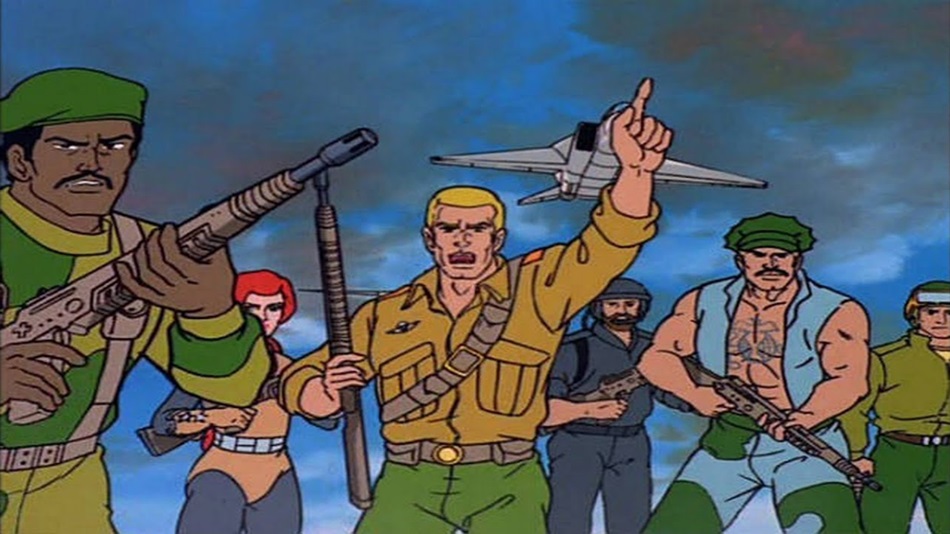
Despite all the typically-’80s things that might be wrong with the series in hindsight, it was still great to to go back into this cartoon and revisit characters and stories that I hadn’t seen in so long. There’s genuine fun to be had here, as long as one remembers that the show is a product of its time.
I’m also happy to report that the spirit of G.I. Joe has lived on past the ’80s.
First, for folks who want to see more, there are there two excellent and highly recommended follow-ups – G.I. Joe: Resolute and G.I. Joe: Renegades. Even though they’re not direct continuations of the original source material, they’re both outstanding spinoffs that have a lot to offer Joe fans. Also, folks who get the itch and would like to track down toys inspired by the ’80s vintage action figures can check into G.I. Joe: Classified, a series of figures and vehicles which revive the plastic spirit of the Joes, but also update them with modern designs, better materials and superior articulation.
I’m quite glad that I went back and rewatched this landmark series from so many years ago. It’s far from perfect and seeing it through rose-colored glasses certainly papered over some of the rough patches I didn’t notice much as a kid, but even when seen from a clear-eyed modern-day perspective, it’s easy to know why G.I. Joe made such a lasting impression and remains a popular property, even to this day.
…And knowing is half the battle!

Transformers fan. MOTU stan. Black Lives Matter, pro-LGBTQIA. Anti-fascist.
- So Videogames Episode 462 - November 15, 2025
- So Videogames Episode 461 - November 9, 2025
- Halls Of Torment: Boglands Link - November 3, 2025
Very nice text, I started collecting again after years, completing vintage Gi Joes