Save The Songstresses!
HIGH Varied player-controlled craft. Fast action. MISSILES EVERYWHERE!
LOW Missing characters. Repetitive sound effects.
WTF Why are all these collectibles just floating in space inside capsules?
Like many of those from a certain generation, I cut my teeth watching Robotech, and I thought it was basically the greatest thing ever. As I grew older, I discovered that while it was a good anime, it was Macross that was spoken of in hushed tones, as the “real” version of the stories I’d come to love. I’ve never gotten to watch that hallowed series, so I jumped at the chance to play the first Macross-based game to receive a full US release, Macross — Shooting Insight. Finally, a chance to immerse myself in this more mature… wait — did that dude just say they need to rescue Sara from the “Bird-Human?”
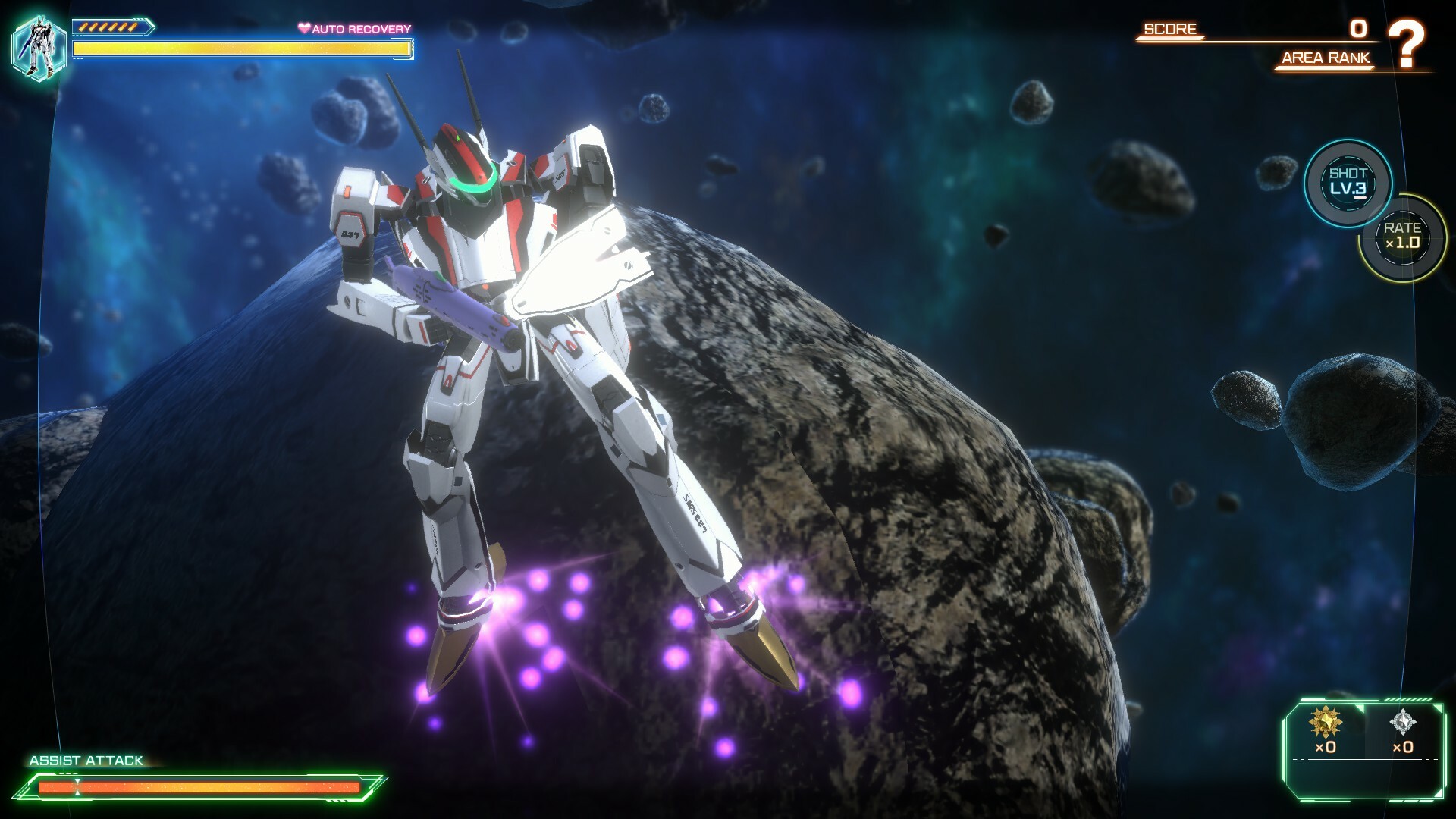
OK, so maybe it doesn’t have the most coherent story. Apparently ripples in space-time brought together pilots from across the Macross saga to rescue kidnapped singers from an evil corporation also ripped from its original time who want to use their voices to power some kind of doomsday machine… and there was something about space whales? Whatever — I get to fly Valkyrie transformable fighter jets (Veritechs for us Robotech fans) and blow lots of stuff up!
At its core, Macross — Shooting Insight is a typical arcade-style shoot ‘em up, albeit with a few cool tricks up its sleeve.
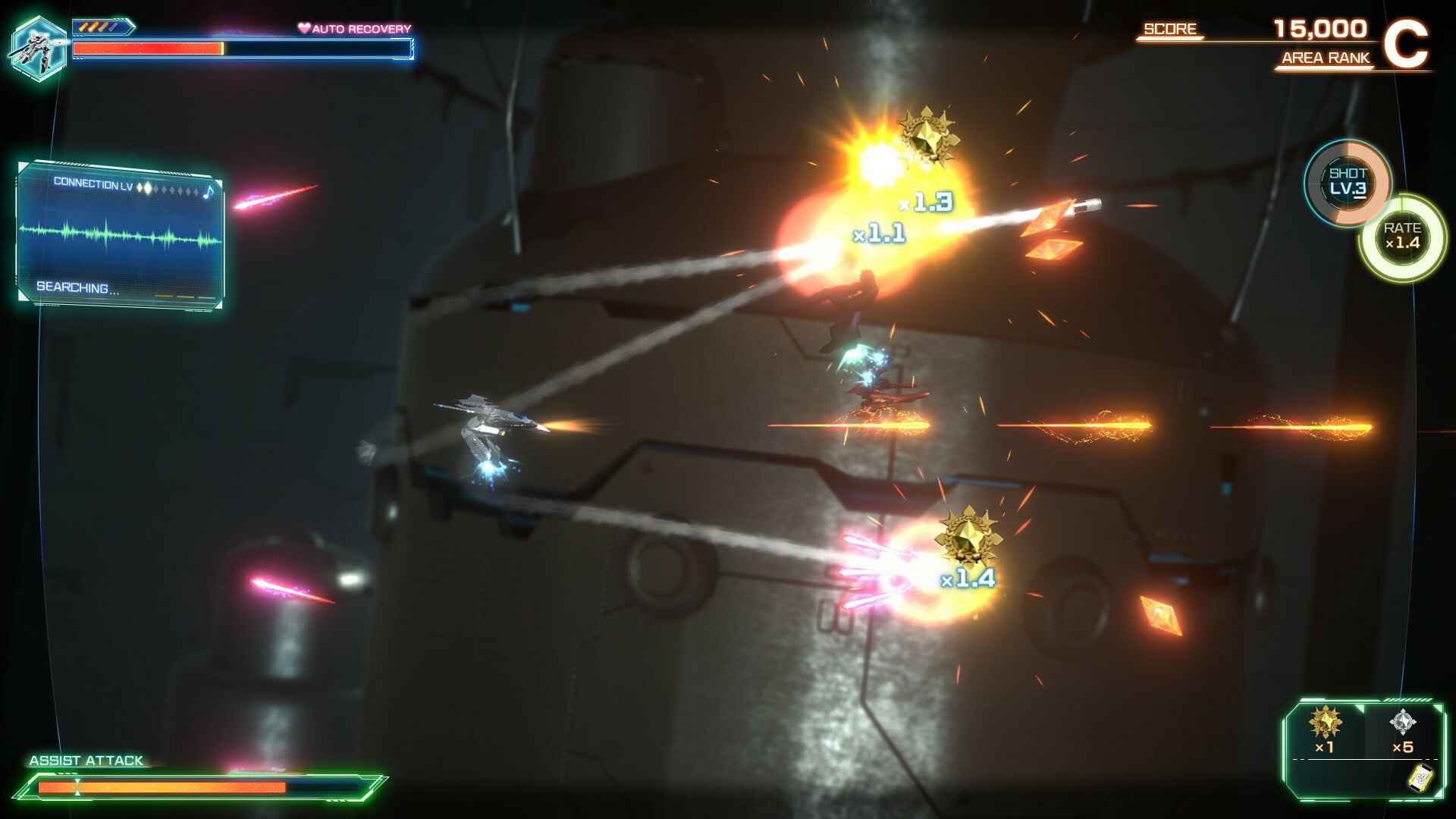
Things start as a top-down shooter, allowing prospective pilots to fire towards the top of the screen at wave after wave of enemies who are raining fire down upon them. The player can move in all directions to evade, and have the ability to dodge button for a split-second if invulnerability when incoming flak is impossible to evade any other way.
Players have two weapons at their disposal to fight off the evil hordes — lasers and missiles. The laser fires in a pre-programmed direction that varies based on the type of fighter being flown. Each playable character has a distinctive ship with a set fire pattern ranging from straight ahead, to a Contra-esque spread gun. Missiles require a lock, which means the player holds a button and moves the ship to lock on to targets, releasing the button to fire. This is generally riskier due to the delay, but missiles are more maneuverable, do more damage, and grant higher score multipliers.
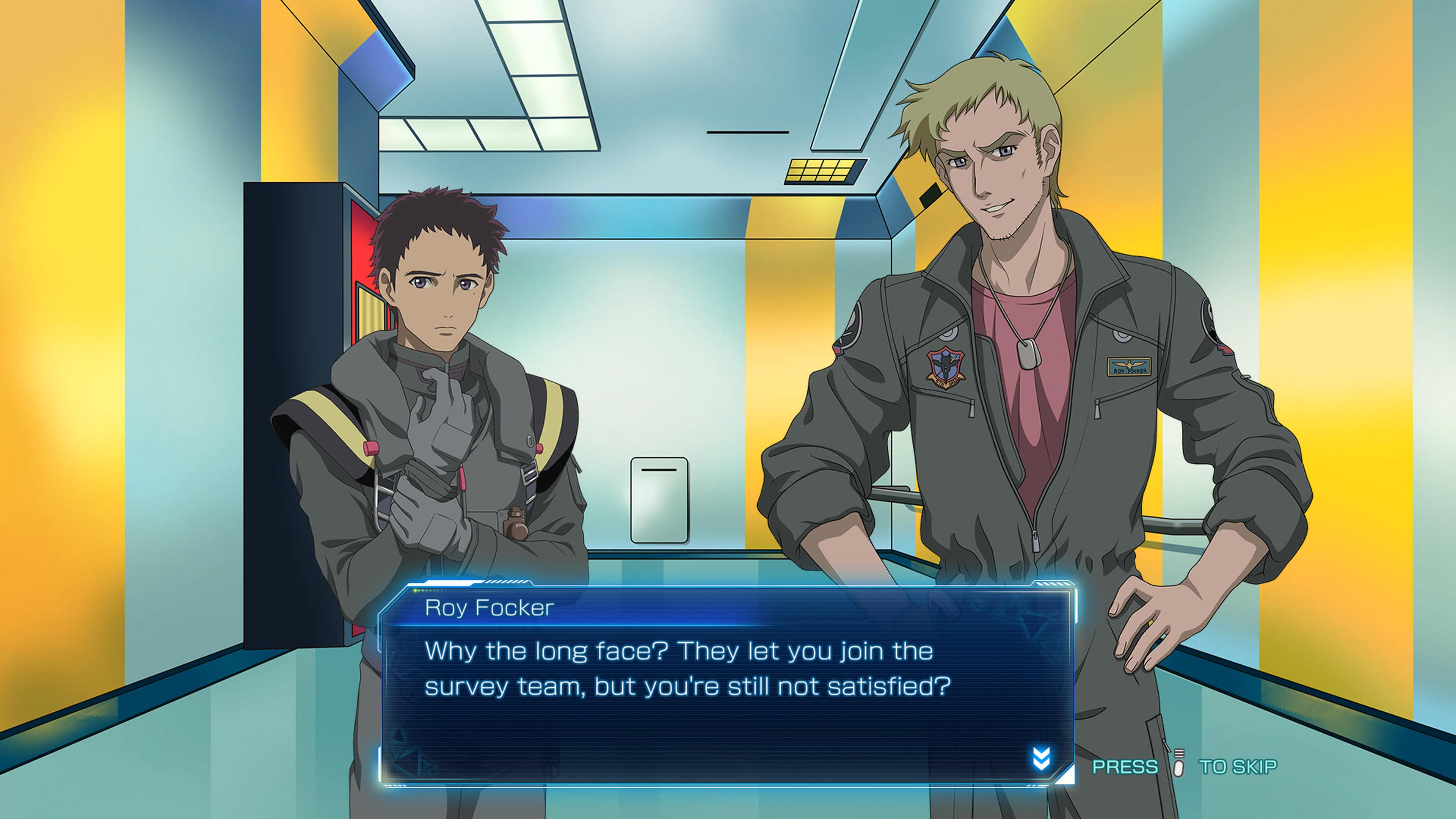
Macross tries to differentiate itself from other shooters by varying gameplay perspective. Along with the top-down sections, there are also side scrolling levels, three-quarter perspective levels where the playfield scrolls with the player’s movement to granting a sort-of open world feel, and third-person behind-the-ship levels. At the end of every stage is a boss battle against an enormous screen-filling monstrosity. Between missions, static cutscenes play where various characters interact, usually talking about how weird it is to have time-traveled or showing wonder at meeting classic heroes such as Roy Fokker.
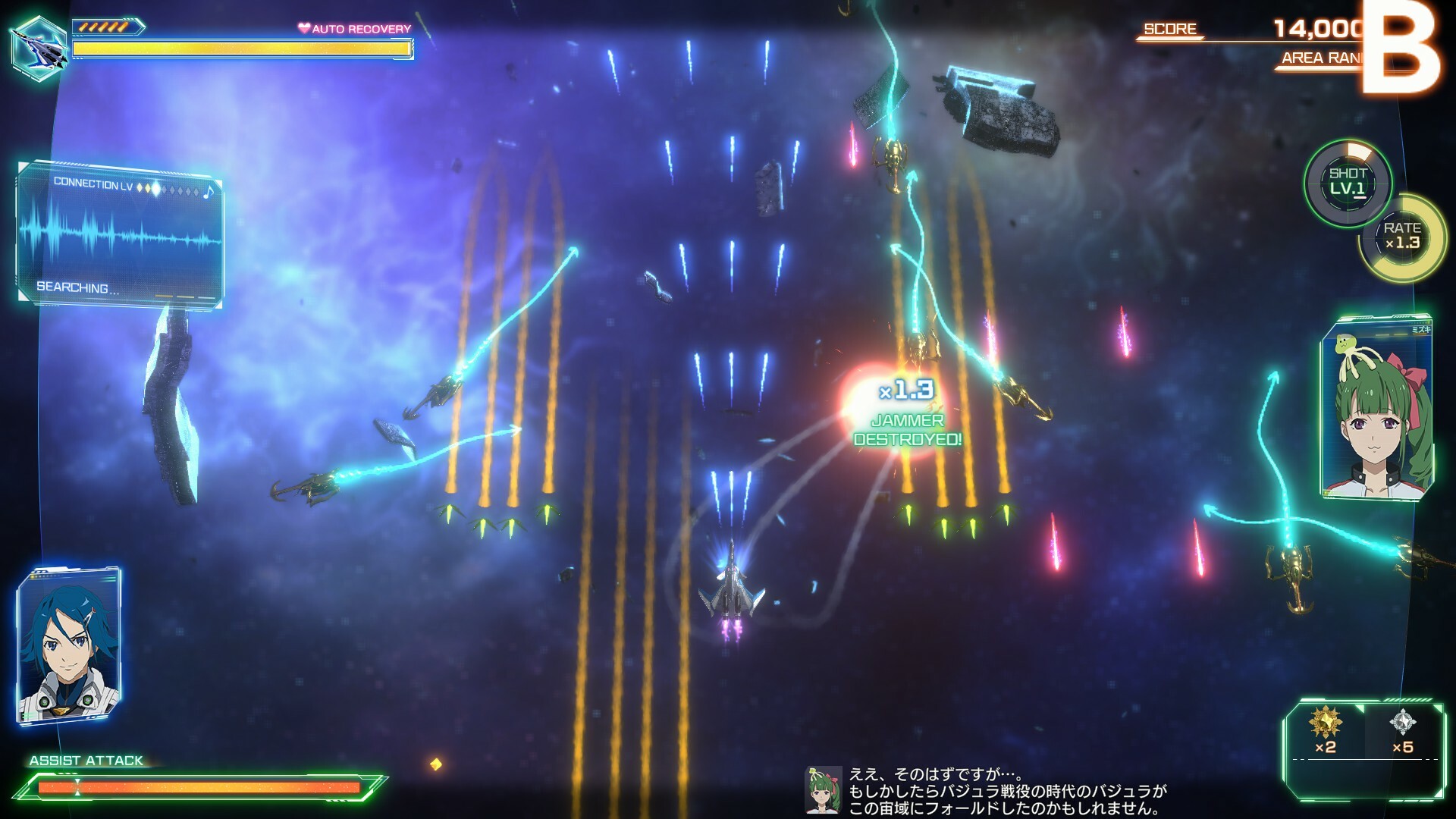
Overall, Macross is colorful, there’s constant action, and the play varies enough to keep interest. There are various floating collectibles in space that unlock gallery items referencing years of Macross lore that was unfamiliar to me, and the soundtrack plays an important part in gameplay — by destroying signal jammers on each stage, the missing songstresses are able to sing to pilots, granting boons such as increased missile damage or greater speed. The songs are a real treat, and provide a tangible reason to try and unlock them in the heat of battle.
As it’s a shooter, difficulty must be part of the conversation, and Macross — Shooting Insight is DIFFICULT on the default settings. Based on the amount of incoming fire and the damage done to the player, the normal mode here feels more like something comparable to Hard or Insane mode in another titles. iThe devs make up for this by being generous with enhancement settings like auto-refill of the health meter when one doesn’t take damage for a few moments, or the option to reduce incoming fire. These enhancements come at the cost of preventing players from placing their high scores on global leaderboards, but the achievements still unlock, and full endings are granted on any setting.
In terms of criticisms, my issues center around quality-of-life issues. For instance, every pilot yells the same phrase EVERY TIME THEY FIRE MISSILES. After a few minutes, I found myself playing more and more of the game on mute due to the incessant repetition.
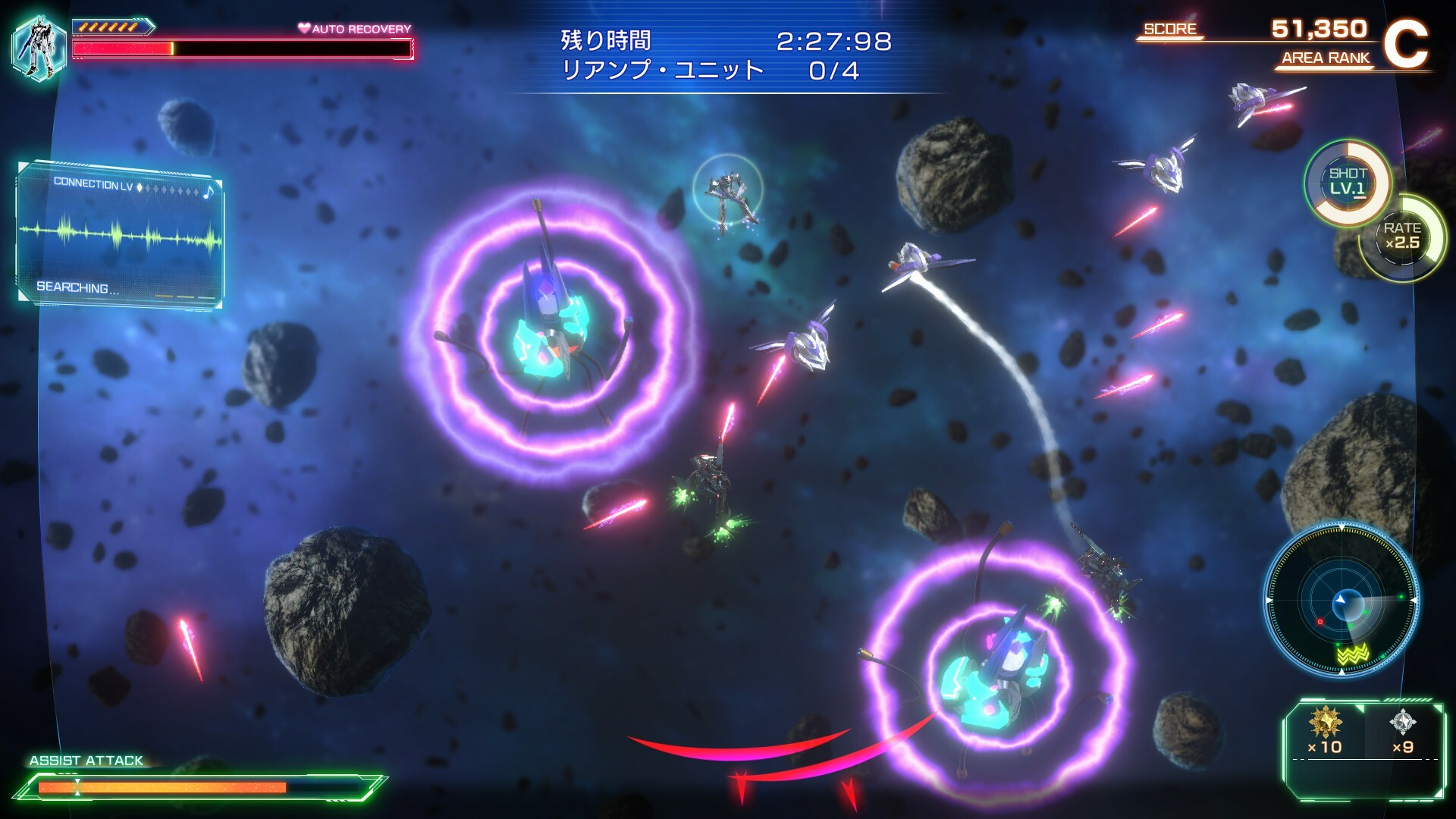
During missions, pilots are generally chatty even when not firing missiles, and have long conversations with just about everyone. All of this dialogue appears at the bottom of the screen, but it’s impossible to read and follow along while fighting for dear life, dodging bullet-hell patterns of fire. If one is able to follow it during play, the result is that the story mode is cute, but doesn’t offer a satisfying narrative or compelling endings (one for each pilot). It’s mostly fanservice, which is fine, if a little lightweight.
However, my biggest issue with Macross is that the Japanese release of Macross — Shooting Insight allows players to use Hikaru Ichijo (Rick Hunter in the US) and his Valkyrie and features Linn Minmay and Misa Hayase as supporting characters. Due to licensing issues, these characters and Rick’s iconic ship are not available to US gamers. While the additional storyline probably wasn’t going to be groundbreaking, excising these key characters from the roster just seems wrong.
The M in Macross – Shooting Insight is not supposed to stand for “missed opportunity,” but sadly, that’s where this title has landed. Fans of the original IP deserve a better representation of the characters, music, and action of the series, and newcomers should be welcomed into the fold by the best the genre and the creative team have to offer. Despite some eye-catching visuals and a fantastic soundtrack, this is not a game I can recommend at its current price without some major overhauls.
Rating: 5 out of 10
Buy MACROSS — Shooting Insight – PC – PS – SW
Disclosures: This game is developed by Kaminari Games and published by Red Art Games. It is currently available on PS45, Switch, and PC. This copy of the game was obtained via publisher and reviewed on the PS5. Approximately 8 hours of play were devoted to the single-player mode, and the game was completed. There are no multiplayer modes.
Parents: According to the ESRB, this game is rated T and contains Fantasy Violence, Language. The official description reads: “This is an arcade-style shooter in which players assume the roles of mecha pilots rescuing songstresses and attempting to return to their respective time periods. From both overhead and side-scrolling perspectives, players traverse space and defeat various enemies (e.g., jammers, unmanned ships, mecha pilots). Players use lasers and missiles to defeat enemies; boss battles contain more protracted combat. Combat can be fast-paced at times, accompanied by laser fire, light effects, and explosions. The word “sh*t” appears in the game.”
Colorblind Modes: There are no colorblind modes available.
Deaf & Hard of Hearing Gamers: This game offers subtitles. The subtitles cannot be altered and/or resized. All storyline dialogue is in subtitle form, but much of the text runs while gameplay is occurring, meaning that it will be hard to follow while avoiding incoming fire. All gameplay audio cues are represented visually. Flavor dialogue (pilots calling out missile launches, occasional chatter) is not subtitled.
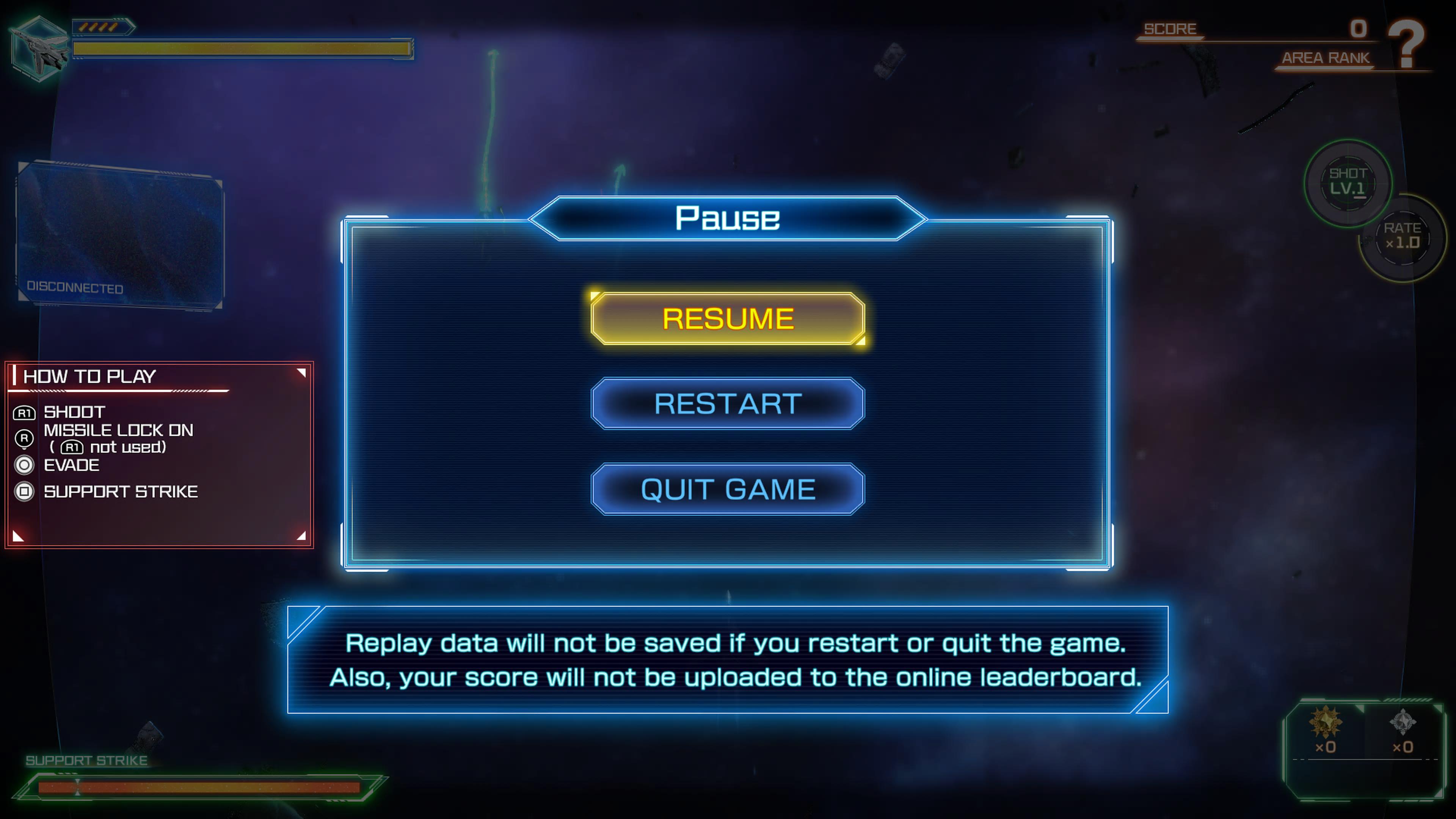
Remappable Controls: Certain functions are remappable. Movement is locked to the control sticks, but all input buttons can be remapped.

He juggles this passion for gaming with his most important job, being a husband and dad.Fortunately, his boys are growing up as gamers (with decidedly more skill, much to his annoyance) and he has a very understanding spouse.
He hangs out on Twitter sometimes as @JPSJeffOrt, Facebook FAR less frequently, and while he misses performing all the interviews from his former online life, he’s much more relaxed now!
- Axis Football 2026 - October 28, 2025
- Dungeons & Dragons Neverwinter Nights 2: Enhanced Edition Review - September 16, 2025
- MACROSS: Shooting Insight Review - May 13, 2025